
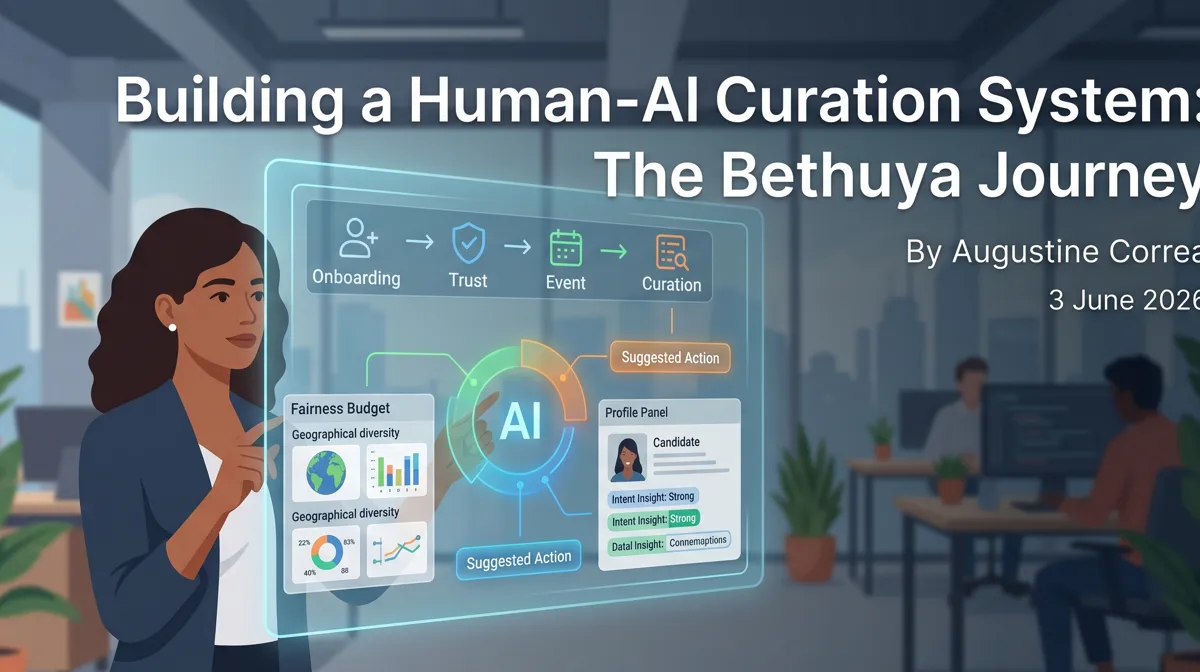
🧩 What is Bethuya?
Bethuya is an open-source, human-in-the-loop community event management system designed specifically for tech community organizers, developer relations (DevRel) teams, and workshop leaders.
Unlike traditional event management platforms that rely on randomized lotteries or first-come-first-served chaos, Bethuya uses local AI orchestration to help human organizers curate high-engagement, balanced, and diverse attendee cohorts from massive application pools.
🧱 The Decision Cockpit
Now that we’ve defined Bethuya as a platform built for intelligent cohort curation, how does it actually look and feel for an organizer?
We stopped thinking in traditional data-entry pages and started thinking in composable, Blazor-style decision components. To fulfill Bethuya’s core promise-helping humans make better, faster decisions -> we built the Decision Cockpit.
The Cockpit isn’t just a dashboard; it is an active feedback loop composed of five core layers:
Fairness Budget (State Layer)
        │
        ▼
Registrant Queue (Triage) ──> Profile Panel (Understanding) ──> Impact Panel (Simulation)
        │
        ▼
Suggested Action (Decision Loop)

1. ⚖️ Fairness Budget (State Layer)
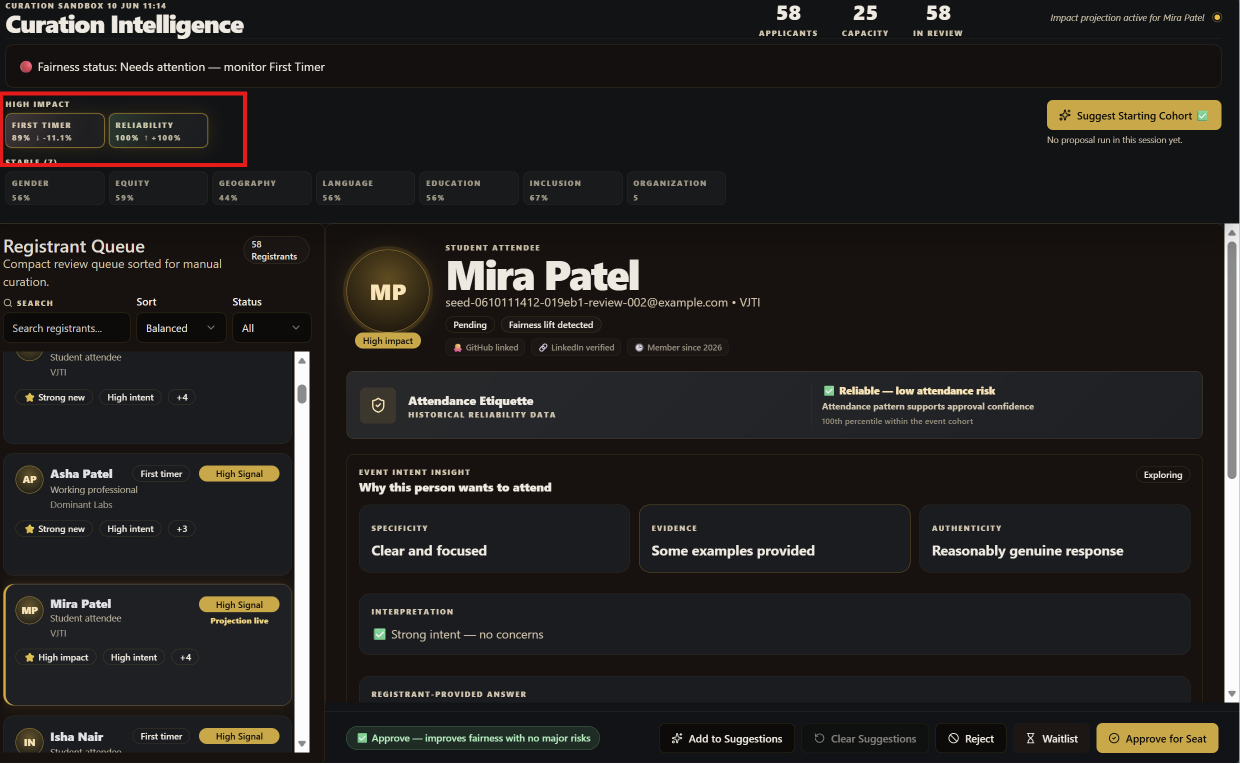
A live dashboard that works like a budget. As you select people, it instantly shows how the cohort is shaping up:
- Geographic spread across Mumbai zones
- Organization concentration
- Mix of students vs professionals
- Other balance signals
It doesn’t block choices - it just makes the consequences visible in real time so humans can adjust.
“What does my cohort look like?”
Example:
LANG 40% ↑ +2.1%
ORG 18% ⚠️
📷 
2. 📋 Registrant Queue - Triage
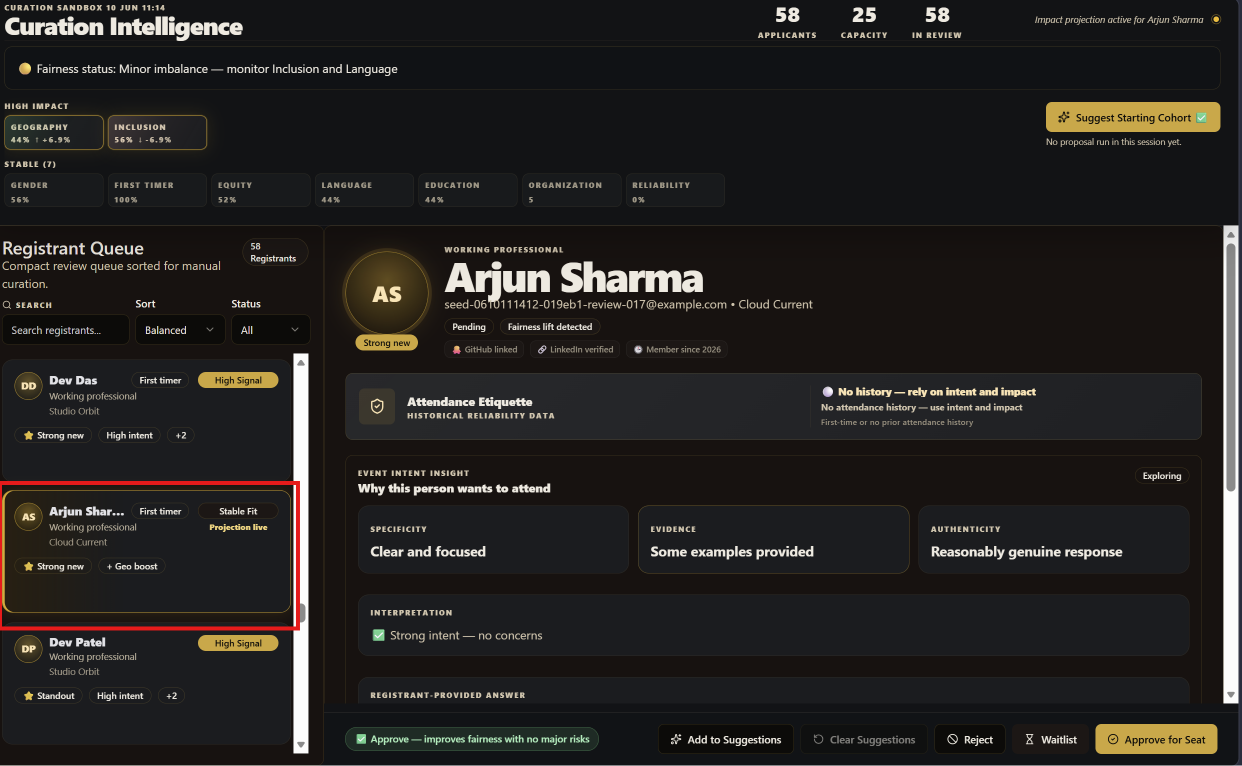
The queue is where curation begins. Instead of sorting by timestamp, the queue compresses complex applications into clear, scannable signals. Local AI surfaces high-intent candidates or highlights underrepresented profiles who might otherwise be lost at the bottom of a spreadsheet. The queue handles the heavy cognitive lifting of attention guidance, not final selection.
“Who should I look at first?”
📷 
3. 👤 Profile Panel - Understanding
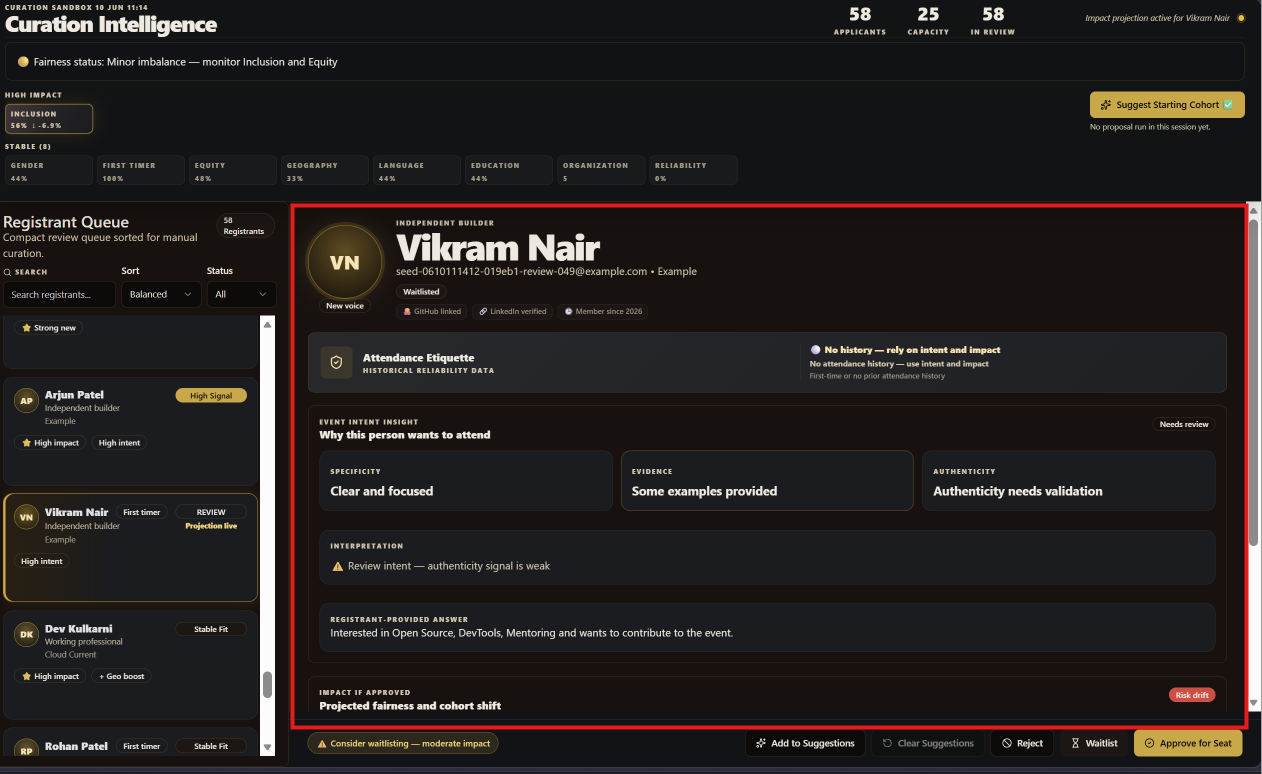
Instead of giving people a single score, the AI extracts insights from their answers - intent quality, genuine technical interest vs generic fluff - and presents them clearly. Explanation always beats score.
“What do I know about this person?”
📷 
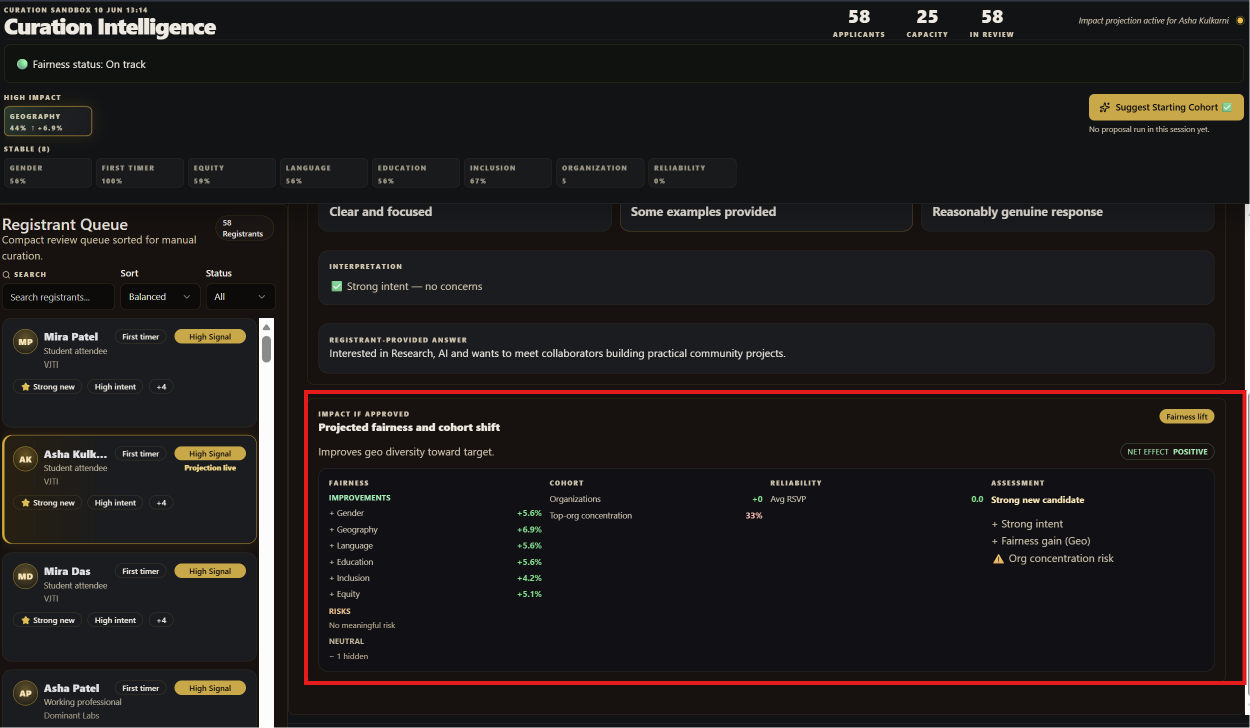
4. ⚡ Impact Panel - Simulation
Before inviting someone, you can see how it affects overall cohort balance. It acts as a sandbox for cohort configuration and provides real-time simulation of trade-offs.
“What happens to the room if we add this person?”
Example:
Improvements:
+ Geo +3.8%
+ Language +2.1%

Risks:
- Org concentration
📷 
5. 🤖 Suggest Starting Cohort
This feature changed everything.
The AI can propose a solid initial list based on all signals and fairness targets. Curators then review, edit, and make the final calls. Human judgment stays in the driver’s seat.
Flow:
Configure → Generate → Review → Edit → Finalize📷 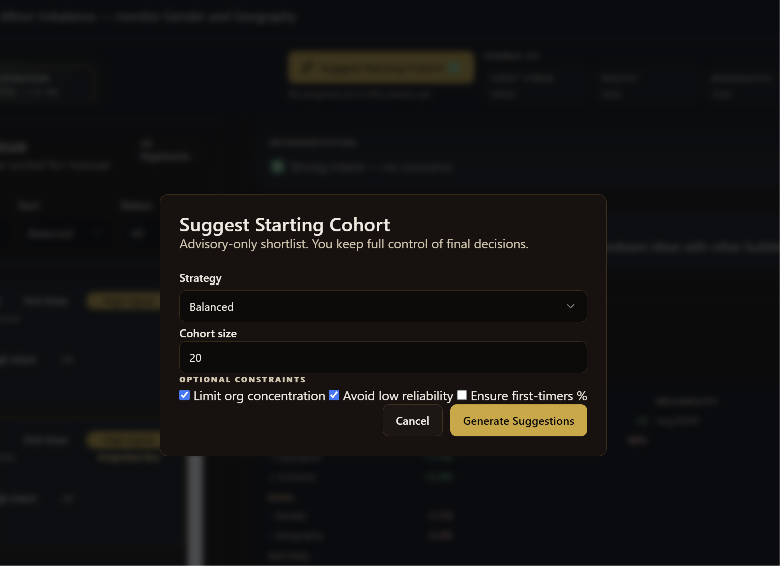
🤖 Where AI Actually Works
We intentionally avoided using AI as a gimmicky layer. It is embedded directly into three specific execution pipelines:
- Intent Understanding: Parsing unstructured long-text answers to extract genuine technical interest.
- Candidate Reasoning: Generating clear, explainable summaries of why an applicant fits the event criteria.
- Cohort Optimization: Solving the complex multi-variable puzzle of balancing geographic distribution, gender diversity, role balance, and community tenure.
📊 AI Flow Diagram
User Data
   ↓
Local Foundry (workstation 💻)/Hosted Agents (Azure ☁️ - South India)
   ↓
Queue → Profile → Impact → Action
   ↓
Human Decision ✅
🔐 Privacy First: Why We Used Foundry Local
When designing an enterprise-grade community tool that handles sensitive personal identifiers and professional data, privacy isn’t a feature - it’s a hard prerequisite. We had to answer a non-negotiable question: Where does user data go when an LLM processes it?
🔒 Our Privacy Guardrail: When we started implementing this, Hosted Agents were not available in India, so we orchestrated our AI workload using Foundry Local via Aspire. By running model serving and orchestration inside our own secure environment, personally identifiable information (PII) and government IDs never leave our boundary.
This gives us the full reasoning power of advanced language models while guaranteeing absolute compliance with Indian data residency standards and zero exposure to external public API training loops.
Since then, Hosted Agents have launched in Azure’s South India region, and we are evaluating them for future iterations. However, our core principle remains the same: AI should assist human decisions without compromising user privacy.
🧠 Final System Model
Trust        → GitHub / LinkedIn
Reliability  → Attendance likelihood
Intent       → Motivation
Impact       → Fairness + Cohort effect
🔥 Key Lessons
Building Bethuya taught us a few fundamental lessons about the intersection of product design, engineering, and community building:
- Don’t collect data - collect signals: More fields create drop-off. Better verification creates high-fidelity signals.
- Separate system layers: Isolate identity verification from event-specific intent.
- AI should assist, not decide: Keep a human expert at the center of the selection loop. AI is for sorting, summarization, and simulation.
- Fairness must be visible: If curators can’t see the systemic impact of their choices in real time, they will unintentionally build monocultures.
In our pilots, this approach cut curation time significantly (from ~75–90 hours down to under 10) while improving geographic and experience diversity in the selected groups. We also caught a few strong candidates who would have been lost in a traditional spreadsheet.
That said, this is still version 1. We expect edge cases, and we know AI can introduce its own biases if we’re not careful. That’s why community feedback is essential.
🚀 Why We Built This
If you’ve ever helped organize events for a thriving technical community in India, you know the feeling. Registrations open and suddenly you’re staring at 5–7x applications of a venue capacity. We get students from multiple Mumbai colleges, working professionals, first-timers trying to break in, veterans, and sometimes entire teams applying together.
The old ways stopped working:
- First-come-first-served just rewarded whoever refreshed Twitter at the right second.
- Spreadsheet roulette turned real people into rows.
- Manual selection led to fatigue and unintentional bias.
We realized the real problem wasn’t collecting more data - it was making fair, high-quality decisions at scale without burning out the curators.
So we built a practical human-AI curation system. We’ve been testing it internally and it’s going live this month for our upcoming events.
✅ Design a system that helps humans make better decisions

🚀 Invitation to the Community
This system debuts this month for our upcoming Build //localhost event. If you apply, you’ll see the new registration flow. If you’d like to help curate or give feedback on the cockpit, reach out - we want experienced community members involved in the process.
Our goal is simple: make it easier to build genuinely high-quality, diverse, and high-energy cohorts while keeping the process transparent and fair.
What started as “how do we fix registration hell” became a more thoughtful way to grow our community. Excited to ship it and hear what you all think.