
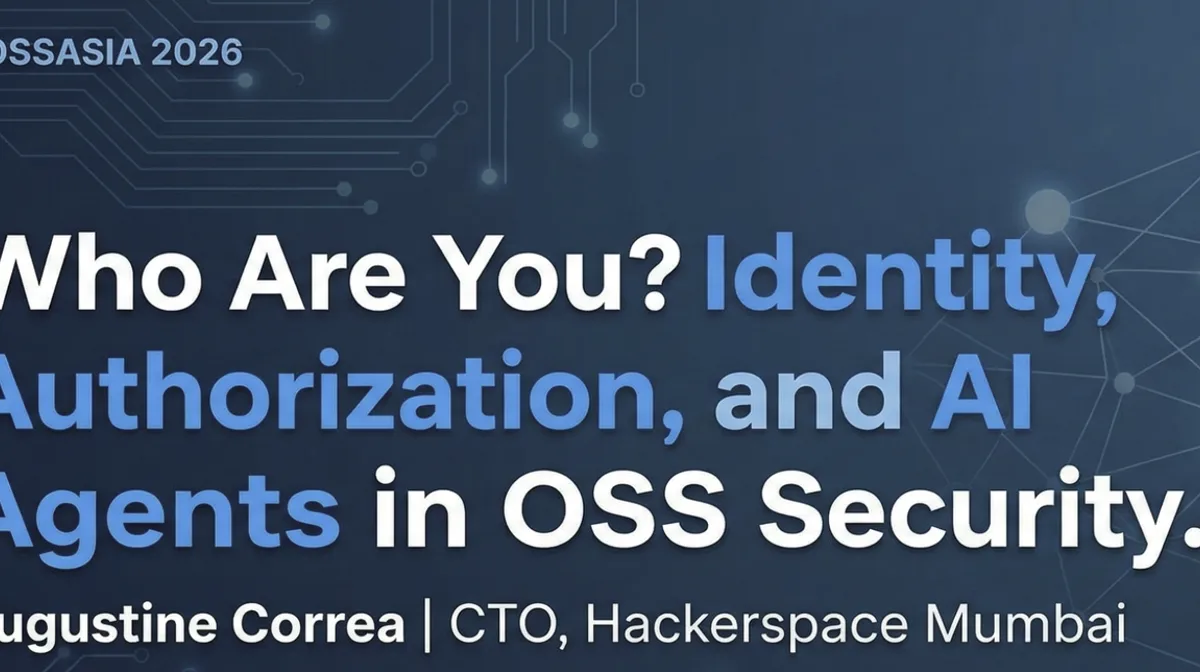
When AI Agents Become Insiders: Security Lessons from FOSSASIA 2026
At FOSSASIA Summit 2026 in Bangkok, my session was about a problem most of us haven’t fully named yet -> but are already experiencing.
📺 Watch the session
YouTube: https://www.youtube.com/watch?v=4dzzzfORqIk
⏱ Timestamp: 2:46:00 – 2:58:00
The talk asked a simple question with uncomfortable implications:
What happens when the biggest insider in your open‑source project… isn’t human?
AI agents are no longer just tools.
They fetch data, join channels, commit code, moderate discussions, and act on behalf of users. That changes the security model at a fundamental level.
Identity Has Shifted, and Our Assumptions Are Breaking

For years, identity evolved along a familiar arc:
- passwords → MFA → biometrics
- humans → services → devices
But 2026 is the first time we’re asking the same identity questions of autonomous agents.
Agents don’t have fingerprints or FaceID.
Their identity is the model — and that immediately breaks long‑standing assumptions:
- Who actually performed an action?
- Who do we audit?
- Who do we revoke?
The era of implicit trust is over. When an AI agent uses a human’s credentials, your logs might say “Augustine did X,” but in reality, Augustine was asleep while a bot acted.
That’s a massive Accountability Gap.
The Silent Killers: API Keys and Recursive Delegation

In the talk, I called out two patterns that consistently show up as security failures:
1. Static API Keys
They’re convenient, and catastrophic.
Giving an agent a long‑lived API key is like leaving your house keys in the lock.
They’re:
- easy to copy
- hard to rotate
- impossible to attribute cleanly
2. Recursive Delegation
Agents creating sub‑agents.
What starts as one assistant quietly becomes a chain of autonomous actors, all operating under inherited privilege — with no natural boundary.
Once delegation becomes recursive, ownership disappears.
The Authorization Gap Nobody Talks About
Identity problems are visible.
Authorization problems are sneaky.
During work on Project Bethuya (our community management tooling), we discovered a failure mode that traditional security models don’t even consider:
Requester ≠ Recipient
An organizer authorizes an agent to fetch sensitive registrant data.
✔️ That retrieval is valid.
But the agent then posts that data into a public community channel.

❌ Suddenly, authorization has failed - not at retrieval, but at output.
Classic OAuth assumes:
The entity that requests data is the entity that consumes it.
AI agents break this assumption every day.
Why OAuth Alone Is No Longer Enough
OAuth was designed for:
- one user
- one application
- one permission boundary
Agents don’t work like that.
They:
- retrieve data with high privilege
- emit output into mixed‑trust environments (Slack, Teams, GitHub discussions)
- act asynchronously
- operate without immediate human review

There is no automatic recomputation of the lowest common denominator of trust before data leaves the agent.
That’s how leaks happen — even when nobody is “doing anything wrong”.
MCP: The New Control Plane (Whether We Like It or Not)
The Model Context Protocol (MCP) is emerging as a standard way for models to interact with tools and resources — often described as the “USB‑C for AI.”

But the key insight from the talk was this:
MCP is not just a protocol.
It’s the new authorization checkpoint.
If enforcement doesn’t happen at the model‑to‑tool boundary, agents gain frictionless access to everything behind it.
MCP gives us structure.
Security has to be layered into that structure - deliberately.
The End of Bearer Tokens (Finally)
Bearer tokens assume one thing:
Whoever has the token is allowed to use it.
That assumption collapses in agentic systems.

DPoP (Demonstrating Proof‑of-Possession) changes the game by:
- binding tokens to cryptographic keys
- ensuring stolen tokens can’t be replayed
- tying usage to a specific agent identity
If we’re serious about secure agents, static secrets have to die.̥̥
Why RBAC Fails and ABAC Becomes Necessary
Roles like:
- admin
- moderator
- contributor
…are far too coarse for autonomous systems.
Agents need access that is:
- time‑bound
- intent‑aware
- context‑sensitive

This is where ABAC (Attribute‑Based Access Control) shines.
Instead of asking:
“Is this agent an admin?”
We ask:
“Should this agent perform this action, right now, under these conditions?”
Precision beats hierarchy.
Case Study: Securing Project Bethuya

In Project̥ Bethuya, we applied these ideas concretely:
- MCP servers act as authorized gateways
- Agents never talk to community data directly
- Permissions are just‑in‑time, task‑scoped, and short‑lived
- Every action is auditable - including intent, not just execution

The result:
- lower risk
- less ambient access
- clearer accountability
- quieter, safer automation
The 2026 Agent Security Checklist

I closed the talk with a simple checklist - worth repeating here:
-
Unique identities for every agent
Never let bots share accounts. -
Short‑lived, DPoP‑bound tokens
Kill static API secrets. -
Full audit trails
Capture intent and action. -
Human‑in‑the‑loop for critical paths
Oversight still matters.
These are not enterprise luxuries.
They’re becoming table stakes for open‑source ecosystems.
How This Connects to Spec‑Driven Development
In our previous blog post —
From Vibes to Verification: Mastering Spec‑Driven Development for AI‑Assisted Coding - we focused on governing what agents build.
This FOSSASIA talk focused on governing what agents are allowed to do.
Together, they point to the same conclusion:
You can’t manage AI systems with vibes - not in code, and not in security.
Specs define intent.
Identity and authorization enforce boundaries.
You need both.
Closing Thoughts
FOSSASIA 2026 made one thing clear:
AI agents are now first‑class actors in open‑source projects.
And every first‑class actor needs:
- identity
- accountability
- constraints
The good news?
All the tools, protocols, and standards shaping this future are open.
The real work - as always - happens in communities.
Let’s build secure agentic systems together.